Until recently, customer service in most mid-sized companies followed a predictable logic: more customers meant more support staff, higher operational costs, and increasing complexity in maintaining consistent quality. It was a linear model — and for a long time, it worked.
Artificial intelligence is now breaking that equation.
Over the past two years, customer service has become one of the fastest areas of AI adoption in business. According to industry estimates, companies globally invested over $200 billion in AI in 2024, with a significant share directed toward automation of customer-facing operations. The reason is straightforward: customer support is both high-volume and highly repetitive — a combination that makes it ideal for automation.
Research consistently shows that between 50% and 70% of incoming customer inquiries fall into predictable categories: order status, delivery times, account access, basic product information. These are not complex, judgment-heavy interactions — they are structured problems. And structured problems are exactly where modern AI systems perform best.
As a result, companies implementing AI-driven support systems are reporting measurable gains. Cost reductions typically range between 30% and 60%, depending on the scale and maturity of implementation. Response times, which previously ranged from several hours to a full business day, are reduced to seconds. In parallel, customer satisfaction scores often increase by 20–30%, largely due to speed and availability rather than complexity of answers.
One of the less discussed, but critical shifts is how this changes the role of human employees. AI does not eliminate customer service teams — it redistributes their focus. Instead of handling repetitive inquiries, employees move toward higher-value interactions: complex problem-solving, relationship management, and revenue-generating conversations. In practical terms, this means that a team of 8–10 people can often handle the same workload that previously required 15–20.
This shift is particularly relevant for mid-sized companies. Unlike large enterprises burdened by legacy systems and rigid processes, mid-sized businesses can implement AI solutions more flexibly. This creates an asymmetric advantage: relatively modest investments can generate disproportionately large efficiency gains.
However, the gap between expectation and reality remains significant for many companies. A common mistake is relying on generic, off-the-shelf AI tools. While these solutions are easy to deploy, they rarely deliver strong business outcomes on their own. Without access to company-specific data, workflows, and communication patterns, even the most advanced models produce generic — and often insufficient — responses.
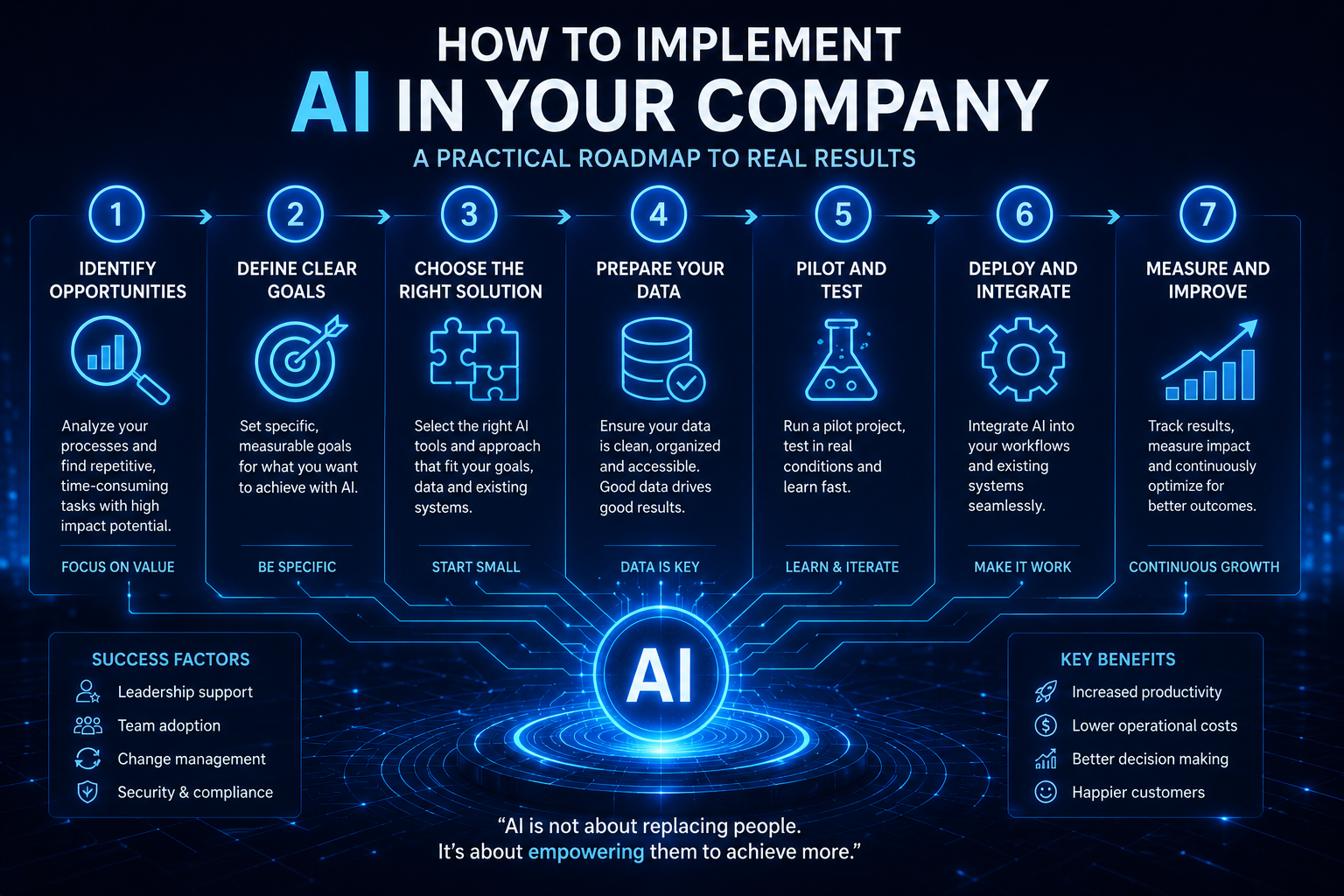
This is where the distinction between experimentation and implementation becomes critical. AI begins to deliver real business value only when it is adapted to the specific context of a company: its internal systems, customer behavior, and operational logic. This often involves integration with CRM platforms, email systems, and internal knowledge bases, as well as training the AI on real interaction data.
At this stage, many companies hesitate — not because of lack of interest, but because of unclear execution. If you're evaluating how such a system could work in your specific case, it may be worth exploring miizstrade.lv, where companies can receive a structured assessment and a tailored implementation approach based on their actual business processes.
From a strategic standpoint, customer service is emerging as one of the highest-ROI entry points for AI adoption. Unlike broader digital transformation initiatives, results here are often visible within weeks rather than years. In many cases, initial deployments begin delivering measurable impact within 2 to 6 weeks, with more advanced integrations completed over a period of 1 to 3 months.
Looking ahead, the trajectory is clear. By 2028, it is estimated that over 80% of customer interactions globally will involve some form of AI, whether fully automated or AI-assisted. As customer expectations shift toward instant, always-available responses, companies that fail to adapt risk not just inefficiency, but competitive irrelevance.
The pattern is familiar. Businesses that delayed adopting e-commerce or mobile platforms did not just lose efficiency — they lost market position. AI is following the same curve, but at a significantly faster pace.
The question is no longer whether customer service will be transformed by AI. That transformation is already underway. The real question is which companies will leverage it early — and which will be forced to catch up later, from a weaker position.