For years, artificial intelligence was discussed as a future advantage — something experimental, promising, but not always clearly tied to profit. That phase is ending. In 2025 and 2026, the conversation has shifted from potential to measurable financial impact.
According to multiple industry reports, over 55% of companies globally are already using AI in at least one core business function, and among those, a growing share report direct revenue increases or cost reductions. More importantly, the gap between companies that actively use AI and those that don’t is widening at an accelerating pace.
What’s becoming clear is that AI does not create value evenly across all areas. Certain functions consistently deliver faster and more measurable returns.
One of the most immediate profit drivers is marketing and sales optimization. AI-driven personalization, recommendation systems, and automated content generation have shown conversion increases ranging from 10% to 30%, depending on the industry. Large e-commerce platforms have been using similar principles for years, but what has changed is accessibility — these capabilities are now available to mid-sized companies at a fraction of the previous cost.
Another major value center is operations. In logistics and supply chain management, AI systems are already reducing costs by 15% to 25% through route optimization, demand forecasting, and inventory balancing. In manufacturing, predictive maintenance powered by AI can reduce equipment downtime by up to 30–50%, directly impacting production efficiency and margins.
Finance is also undergoing a quiet but significant transformation. AI models are increasingly used for risk analysis, fraud detection, and cash flow forecasting. In some cases, companies report up to 40% faster financial decision-making cycles, allowing them to react more quickly to market changes.
Yet, perhaps the most underestimated impact lies in internal productivity. AI copilots and assistants — integrated into daily workflows — are enabling employees to complete tasks significantly faster. Studies suggest productivity gains of 20% to 40% in roles that involve communication, analysis, or content creation. For a mid-sized company, this is equivalent to scaling output without proportionally increasing headcount.
Despite these gains, many companies remain stuck in what could be described as the “tool phase.” They experiment with publicly available AI tools, achieve incremental improvements, but fail to translate them into structural advantages. The missing link is not technology — it is integration.
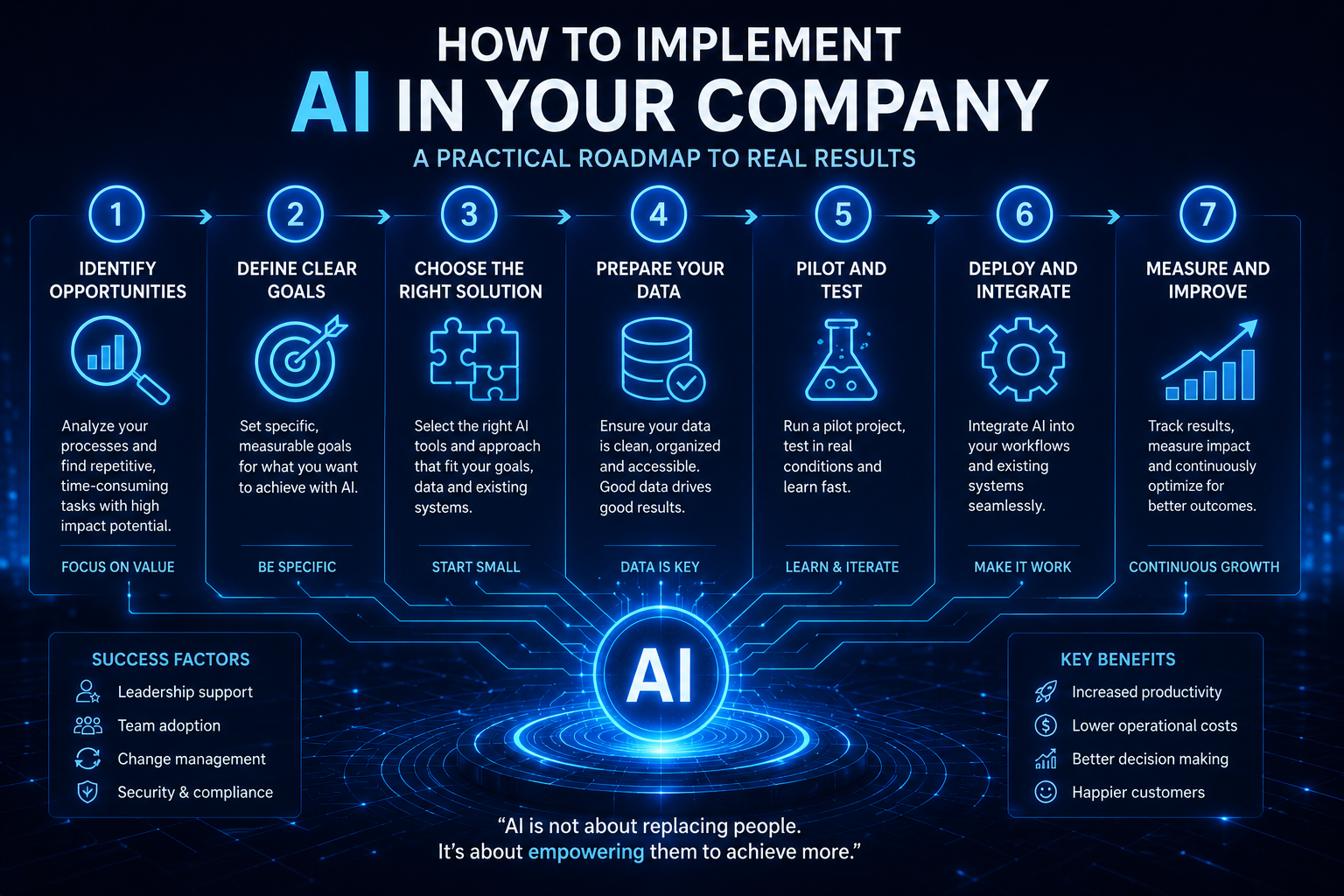
Real profitability emerges when AI is embedded into business processes, not used as an external add-on. This requires alignment with internal systems, data flows, and decision-making structures. Without this, AI remains a productivity boost for individuals rather than a growth engine for the company.
This is also where the difference between early adopters and late movers becomes more pronounced. Early adopters are not just using AI — they are learning how to use it strategically. They understand where it drives margin, where it reduces risk, and where it creates competitive differentiation.
For many mid-sized companies, the challenge is not whether AI could be useful, but how to prioritize and implement it effectively. If approached correctly, AI adoption does not require massive upfront investment. In many cases, the first profitable use cases can be identified and deployed within a matter of weeks.
If you’re evaluating where AI could generate the highest return in your specific business, it can be useful to start with a structured assessment. Platforms like miizstrade.lv offer exactly that — a way to map AI opportunities to real business processes and estimate their impact before committing to implementation.
Looking ahead, the trajectory is becoming difficult to ignore. By 2030, AI is expected to contribute up to $15.7 trillion to the global economy, according to PwC estimates. However, this value will not be distributed evenly. Companies that integrate AI early and effectively will capture a disproportionate share.
The shift is already happening. AI is no longer an experimental advantage — it is becoming a core driver of profitability.