Many businesses first encounter artificial intelligence through content generation, research assistance, or brainstorming tools. While these use cases are valuable, they rarely represent the biggest opportunity.
The real transformation begins with automation.
Every organization contains processes that repeat dozens or hundreds of times each day. Customer inquiries, document processing, reporting, data entry, email management, and information retrieval all consume valuable time.
Individually, these tasks may seem small. Collectively, they can occupy a significant portion of a company's workforce.
This is where AI changes the equation.
Traditional automation relied on fixed rules and predictable workflows. Modern AI can work with unstructured information. It can understand written requests, analyze documents, categorize information, and perform decisions that previously required human judgment.
Because of this capability, AI automation has become one of the fastest-growing investment areas worldwide.
The practical outcomes are often less dramatic than marketing headlines suggest but considerably more valuable. Employees spend less time on repetitive work. Customers receive faster responses. Managers gain access to timely insights without waiting for manually prepared reports.
The most successful projects rarely involve replacing entire departments. Instead, they focus on removing friction from critical workflows.
As a result, many companies are no longer asking whether automation is necessary. They are asking where they should begin.
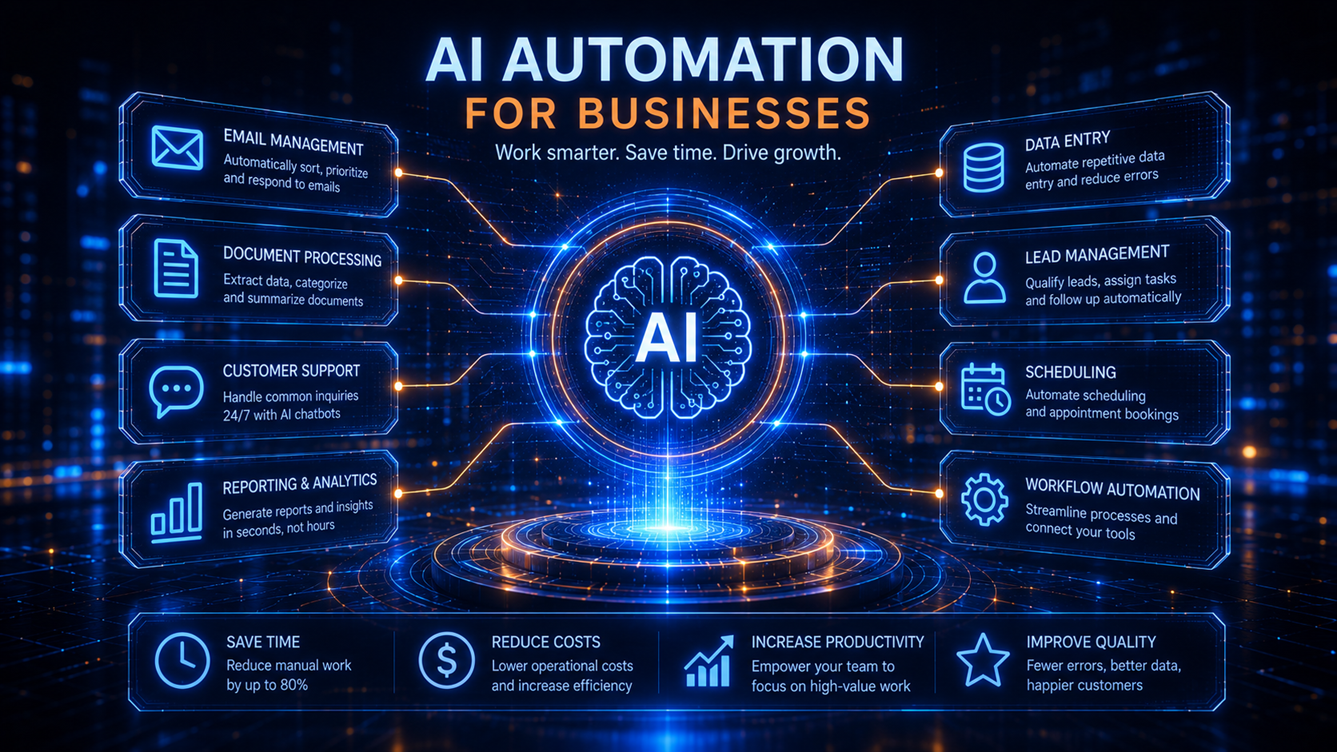
Discover how AI automation helps businesses reduce costs, streamline operations, and improve productivity across teams.